




Best Heat Transfer Vinyl for Shirts: 10 Films Compared
 Published
 Updated
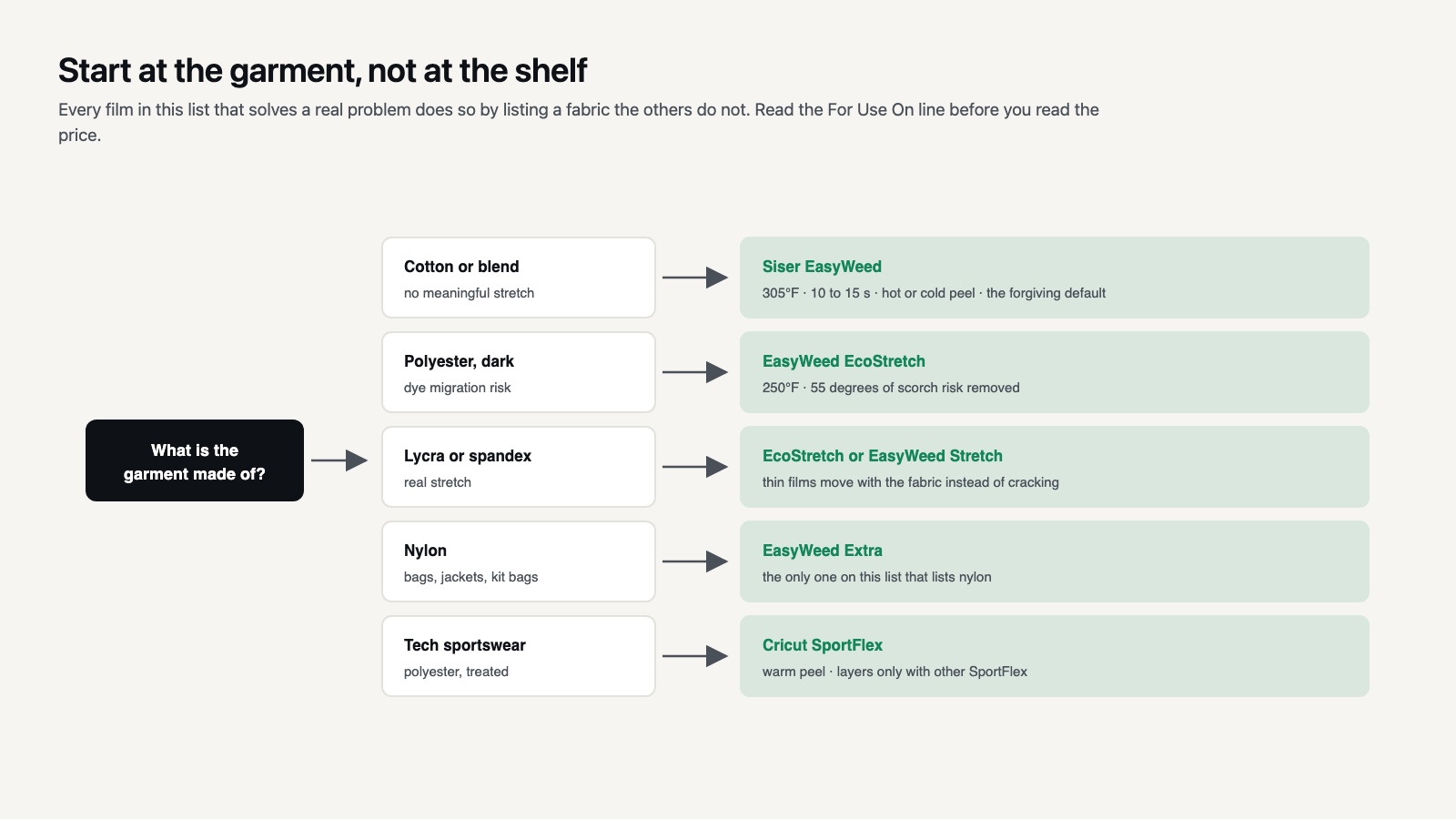
The best heat transfer vinyl for shirts is the one rated for the fabric you are pressing. Siser EasyWeed is the default for cotton and blends, EasyWeed Extra is the one that bonds to nylon, and stretch rated films are the only ones that survive activewear. Color and finish come after that.
Almost every list of the best heat transfer vinyl for shirts gets this backwards by ranking films on feel and price. A film that presses beautifully on a cotton tee will peel off a polyester jersey in two weeks, and no amount of extra pressure fixes it. The fabric decides the film.
Ten films are covered below, each with the manufacturer’s own published application settings rather than remembered numbers, plus where each one fails. Every setting quoted comes from the maker’s technical documentation. If you have not pressed HTV before, start with the HTV and infusible ink walkthrough and come back when you are choosing materials rather than learning the process.
How to Read This List
Ten candidates for the best heat transfer vinyl for shirts, grouped loosely from most general to most specialized. You are not meant to own all of them. Most working crafters keep two: one everyday film in their main colors and one specialty film for whatever their customers ask for most.
The selection criterion throughout is published fabric compatibility and published application settings. Where a manufacturer states a figure, it is quoted. Where one does not, the entry says so rather than filling the gap with an estimate.
📌 Did You Know?
Siser prints a revision date on its application instruction sheet, currently 09-17-2025. Manufacturers update these documents as formulations change, so a settings chart screenshotted from a blog three years ago may no longer match the film in your hand. Download the current sheet rather than saving someone else’s picture of it.
1. Siser EasyWeed
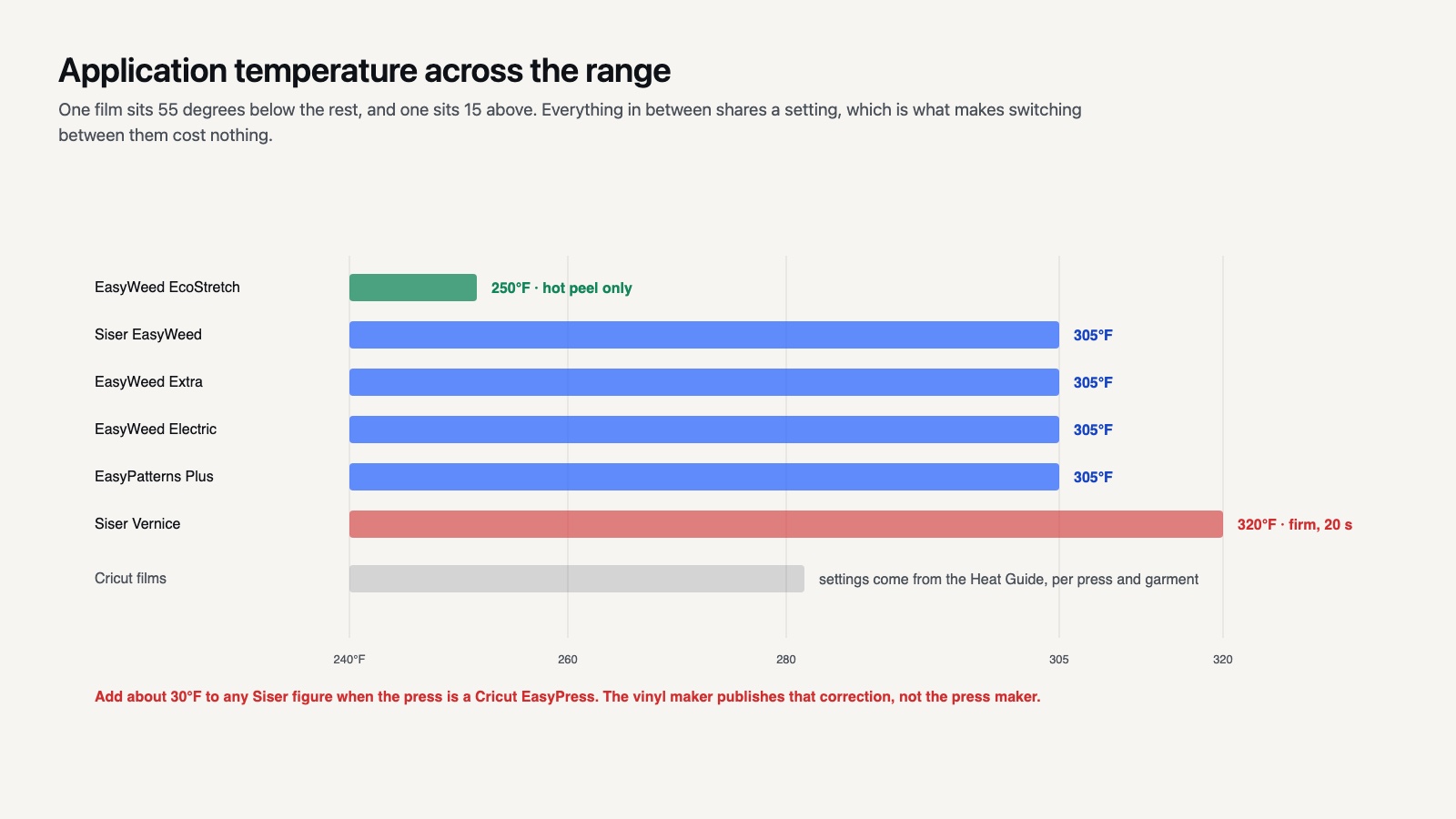
For use on: 100% cotton, poly/cotton blends, 100% polyester, leather | Heat press: 305°F / 150°C | Pressure: medium, 10 to 15 seconds | Peel: hot or cold
This is the reference film that every other one gets compared against, and it earns the position by being forgiving rather than by being best at anything. EasyWeed is made by Siser, an Italian manufacturer whose North American arm publishes application instructions for its whole range in a single document.
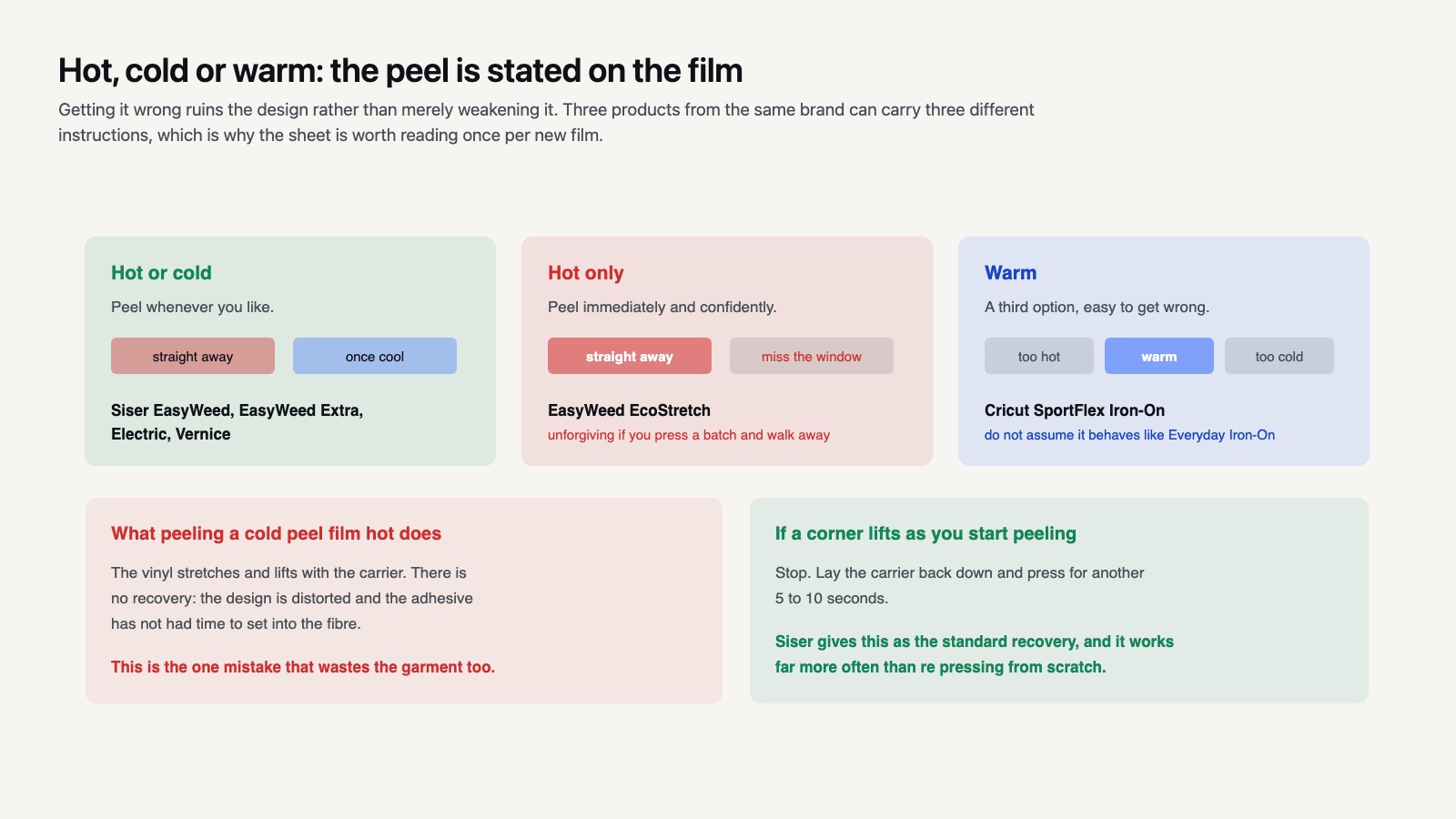
The hot or cold peel is the reason beginners should start here. Most films are one or the other, and peeling at the wrong temperature ruins the transfer. EasyWeed removes that failure mode entirely. Siser’s published settings have been unchanged for years, which also means the numbers you find in an old tutorial are still correct.
Its limitation is that it is unremarkable everywhere else. It is not the thinnest, not the stretchiest, and on very fine detail it weeds no better than average. If your work is all lycra sportswear or all nylon bags, a specialized film in this list will outperform it.
Best for: cotton and blend shirts, and anyone who wants one film that mostly works.
Watch for: it is not stretch rated, so it will crack on activewear.
2. Siser EasyWeed Extra
For use on: 100% cotton, poly/cotton blends, 100% polyester, nylon | Heat press: 305°F / 150°C | Pressure: medium, 10 to 15 seconds | Peel: hot or cold
EasyWeed Extra exists for one reason: nylon. Standard HTV does not bond to nylon at any setting you can safely apply, which is why bags, windbreakers and umbrellas defeat most crafters on their first attempt.
The settings are identical to standard EasyWeed, 305°F and medium pressure for 10 to 15 seconds, so switching between the two costs nothing in workflow. The difference is entirely in the adhesive formulation. Siser lists nylon explicitly on its application chart for this film and does not list it for the standard version, which is the clearest possible statement of what you are buying.
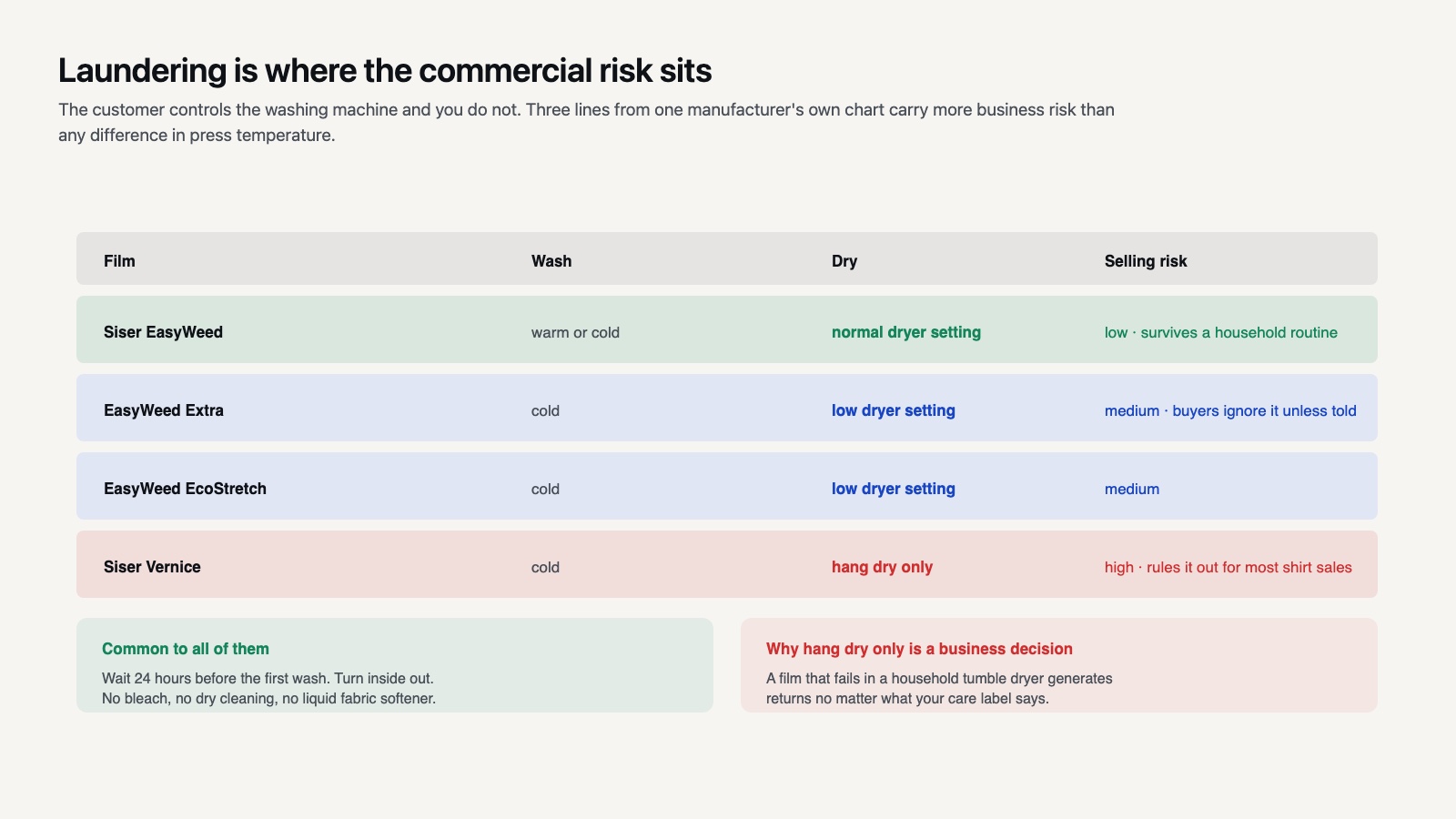
Laundering guidance is stricter than for standard EasyWeed: wash cold and dry on low rather than the normal dryer setting. That matters for customer instructions if you are selling.
Best for: nylon bags, jackets, sports kit bags and anything slick and synthetic.
Watch for: the cold wash and low dry requirement, which buyers ignore unless you tell them.
3. Siser EasyWeed EcoStretch
For use on: cotton, poly/cotton, polyester, Lycra and spandex | Heat press: 250°F / 120°C | Pressure: medium, 10 to 15 seconds | Peel: hot only
EcoStretch is Siser’s water based film, made without the solvent chemistry of the rest of the range, and it is also the one that handles spandex.
The 250°F application temperature is the number to notice. That is 55 degrees cooler than standard EasyWeed, which makes it the sensible choice for anything heat sensitive, and it is 55 degrees of scorch risk removed on dark polyester where dye migration is a constant worry. Pressing cooler also means less time waiting for a press to come up to temperature between colors.
The catch is the peel. EcoStretch is hot peel only, with no cold peel option, so you have to peel immediately and confidently. Miss the window and the carrier fights you.
Best for: leggings, swimwear, dance kit and any garment with real stretch in it.
Watch for: hot peel only, which is unforgiving if you press a batch and walk away.
4. Siser EasyWeed Stretch
Type: Siser’s thinnest HTV | Home iron: firm pressure, 20 to 25 seconds | Notable: requires firm pressure, mat not recommended
EasyWeed Stretch is described by Siser as its thinnest film, built for stretchability and rebound. Thinness is the feature: a thin film moves with the fabric instead of resisting it, which is what stops cracking across a chest print on a fitted shirt.
The pressure requirement is unusual and Siser is blunt about it. Their guidance says you may need to use a low table or work on the floor to get enough body weight over an EasyPress, and that you should not use the pressing mat, because the mat absorbs the pressure this film needs. That is a specific, practical instruction that almost no third party tutorial mentions.
Being thin cuts both ways. On a home cutter the film is easy to cut through the carrier if your blade pressure is set for a thicker material, so run a test cut when you first switch to it.
Best for: fitted shirts, ribbed fabric and anything where a stiff print would look wrong.
Watch for: the firm pressure requirement, which most home setups cannot deliver on a padded surface.
⚠️ Common Mistake to Avoid
Assuming a film’s stretch rating covers the garment. A stretch film on a non stretch shirt is fine; a standard film on leggings will crack at the first wear whatever the press settings were. The film has to match the garment’s behavior, and the shirt design matters too, since a large solid block cracks where fine lettering would flex.
5. Siser EasyWeed Electric
For use on: cotton, poly/cotton, polyester, leather | Heat press: 305°F / 150°C | Pressure: medium, 10 to 15 seconds | Peel: hot or cold
Electric is Siser’s metallic finish, and the useful thing about it is that Siser groups it with standard EasyWeed on the application chart. Same temperature, same time, same pressure, same peel options.
That matters because metallic films from other ranges usually carry their own settings and their own restrictions. Being able to layer a metallic accent over a standard EasyWeed base without changing the press setting removes a whole class of mistakes on multi color work.
The finish is a genuine metallic sheen rather than glitter, so it reads as premium at arm’s length and does not shed particles into your weeding. It is also noticeably more expensive per sheet than plain EasyWeed, which is the honest trade. Accents work best when they are small, which is a design decision made before you cut rather than at the press, and layered character and cartoon designs are usually built that way already.
Best for: single accent elements in a layered design, monograms and lettering.
Watch for: price per sheet, and the fact that a full metallic design looks cheap rather than expensive.
6. Siser Vernice
For use on: cotton, poly/cotton, polyester | Heat press: 320°F / 160°C | Pressure: firm, 20 seconds | Laundering: hang dry only
Vernice sits apart from the EasyWeed family in every respect, and its numbers show it. At 320°F for a full 20 seconds with firm pressure, it demands more from your press than anything else in this list.
The laundering instruction is the one that should decide whether you use it commercially. Siser specifies hang dry only. Not low dryer, not tumble dry inside out, hang dry. If you are selling shirts to the general public, a film that fails in a household dryer will generate returns no matter what your care label says.
For personal projects and for customers who understand the care requirement, the finish is the reason to accept that. It is a high gloss lacquer style film that looks nothing like ordinary matte HTV.
Best for: statement pieces and personal projects where care instructions will be followed.
Watch for: hang dry only, which rules it out for most commercial shirt work.
7. Siser Glitter
Type: thick specialty film | Layering: top layer only | Cutting note: may need a second pass
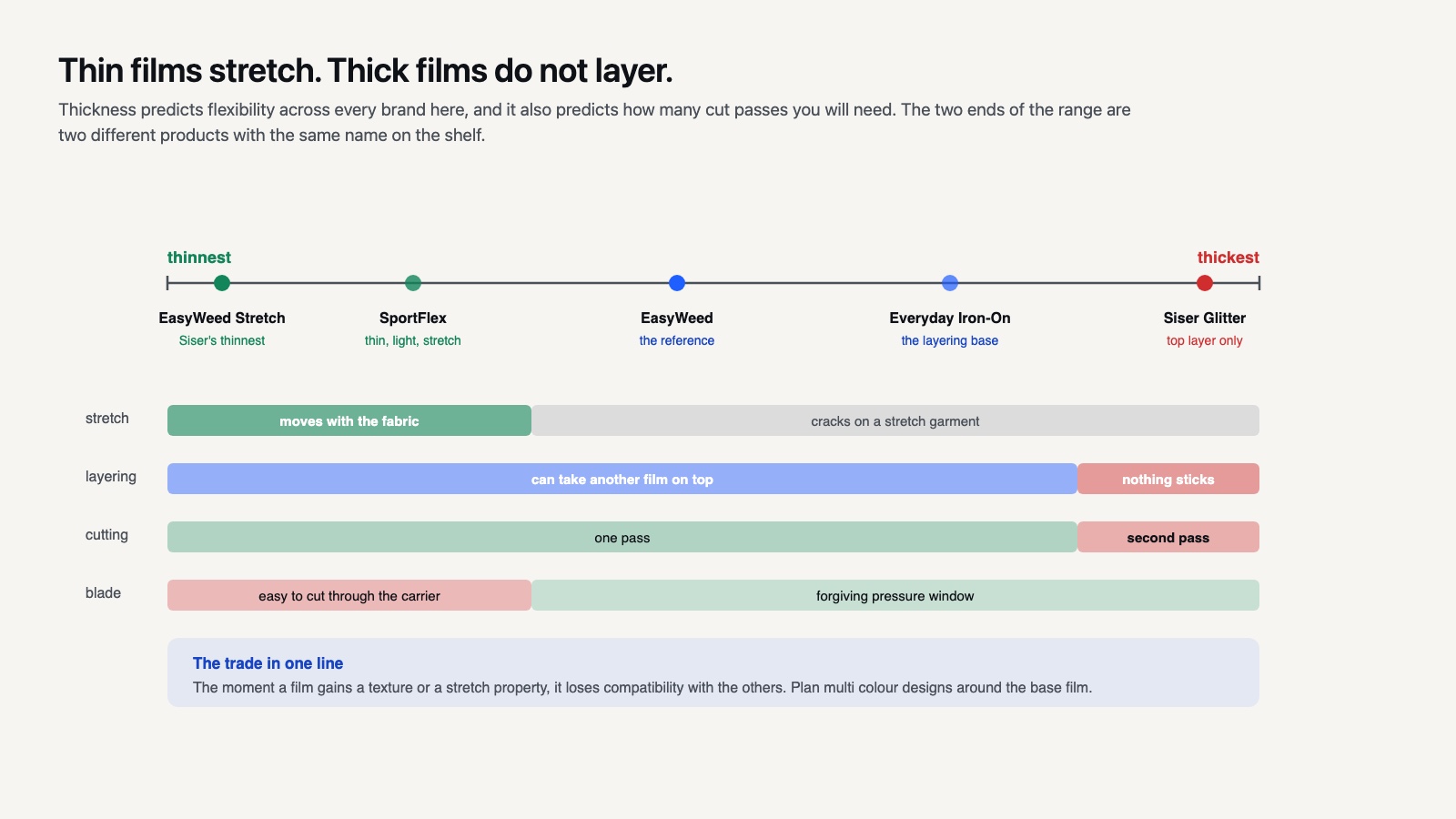
Glitter HTV is the film customers ask for and crafters resent, and the reason is thickness. Siser notes that when combining a thin die with a thick HTV such as Glitter, you may need to run the sandwich through the cutting machine a second time to cut fully through.
The same thickness that makes it awkward to cut makes it awkward to layer. Glitter is a top layer film: nothing bonds reliably on top of its textured surface. Designs that need glitter plus a second color have to be planned as adjacent shapes rather than stacked ones.
It also needs strong grip transfer handling if you are combining it with adhesive vinyl work, since its surface only presents high points for an adhesive to grab. That is the same problem covered in the vinyl application guide, and it applies to any textured film.
Best for: single color lettering, dance and cheer designs, children’s names.
Watch for: second cut passes, top layer only, and shedding that gets into your other materials.
8. Cricut Everyday Iron-On
Range: over 28 colors plus samplers | Layering: base layer for any other Cricut iron-on | Format: sheets and rolls
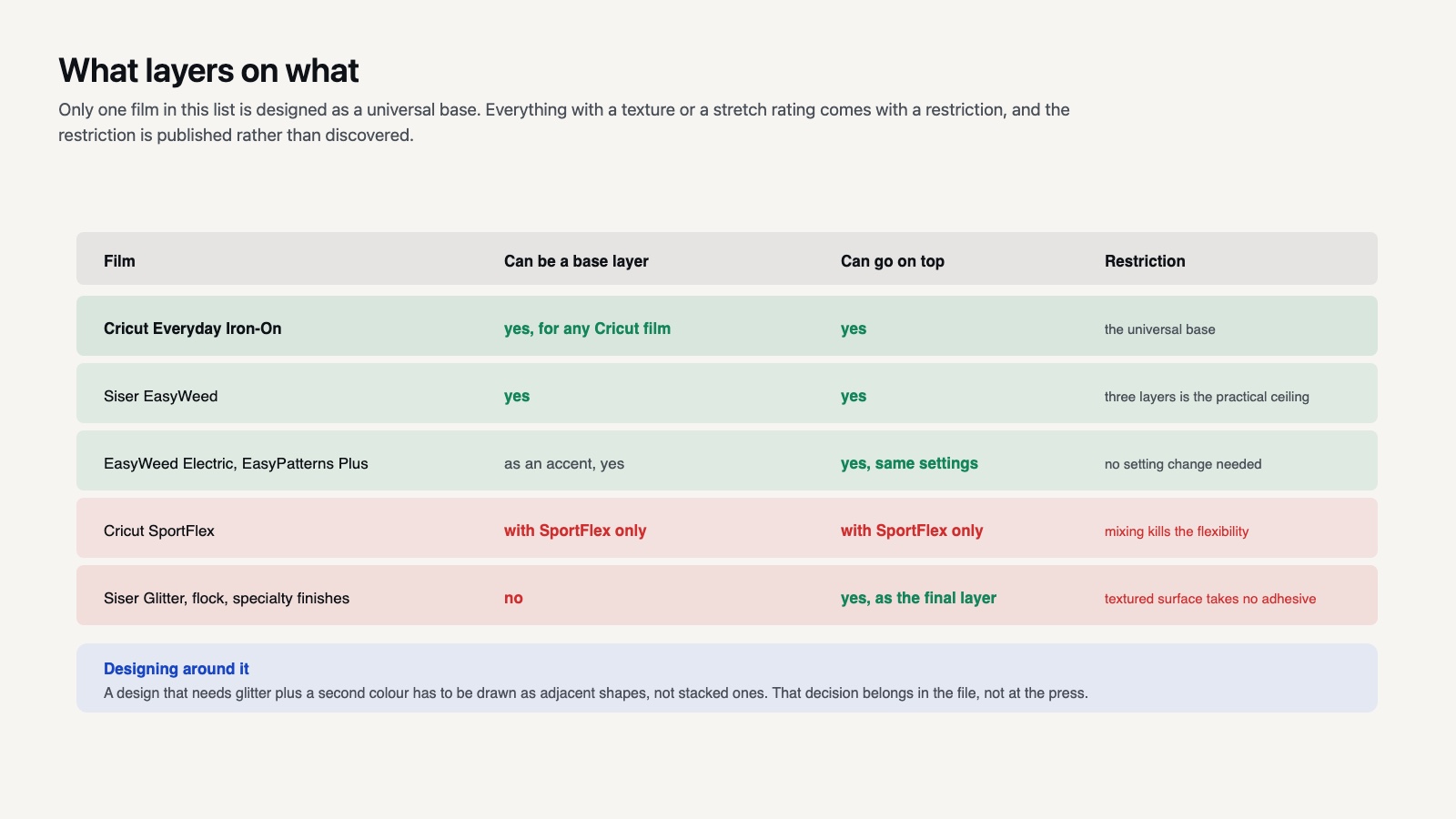
Cricut Everyday Iron-On is the house film, and its defining property is layering. Cricut states that Everyday Iron-On is the one type of its HTV that can act as a base layer with any other Cricut heat transfer material on top of it.
For multi color designs inside the Cricut ecosystem that makes it the structural choice: build the base in Everyday, add specialty films above. Cricut also publishes settings through its Heat Guide, which returns temperature and time for the exact combination of film, garment and press rather than giving one number for everything.
The honest criticism is price and availability. Cricut film costs more per square inch than Siser in most markets, and the color range, while wide, is narrower than the professional sign supply channel. You are paying for the integration with Design Space and the Heat Guide.
Best for: multi layer designs pressed with a Cricut EasyPress and the Heat Guide.
Watch for: cost per sheet against equivalent sign trade film.
9. Cricut SportFlex Iron-On
Designed for: polyester and nylon tech fabrics | Properties: thin, lightweight, stretch and flex | Peel: warm | Layering: with SportFlex only
SportFlex Iron-On is Cricut’s activewear film, and Cricut is specific about its limits in a way that is genuinely useful.
Cricut states that SportFlex should only be layered with other SportFlex, because mixing it with a stiffer film destroys the flexibility that the design needs on a stretch garment. It also specifies a warm peel, which is a third option distinct from hot and cold and easy to get wrong if you assume it behaves like Everyday Iron-On.
Cricut recommends it for tech fabrics, meaning polyester and nylon sportswear. On cotton it works but adds nothing, and you would be paying a premium for stretch you do not need.
Best for: running tops, leggings, football shirts and gym wear.
Watch for: warm peel and the no mixed layering rule, both easy to forget mid batch.
10. Cricut Smart Iron-On
Key feature: loads without a cutting mat on compatible machines | Format: long rolls | Use: large and repeated designs
Smart Iron-On is a format choice more than a material choice. On compatible machines it feeds directly without a mat, which removes the length ceiling a mat imposes.
For long designs, banners across the back of a shirt, or batches where you want to cut fifteen copies in one continuous run, that is a real workflow saving. A mat also loses tack over time and picks up fiber, and taking it out of the process removes a consumable and a failure point.
Two caveats. It requires a Smart material compatible machine, which the older Explore Air 2 and original Maker are not. And it costs more per square inch than mat cut film, so using it for small one off designs is paying for a capability you are not using. Machine compatibility is worth checking against the current machine chart before buying a roll.
Best for: long designs and repeat production runs on Smart compatible machines.
Watch for: machine compatibility and the price premium on small jobs.
💡 Pro Tip
Buy a sampler pack of one film rather than single sheets of five different films. Learning how one material behaves on your press, at your pressure, on your usual blanks is worth more than a drawer of partly used colors. Most people who say a film is unreliable are describing their first three sheets of it.
At a Glance
| Film | Fabric | Temp | Best for |
|---|---|---|---|
| Siser EasyWeed | Cotton, blends, poly, leather | 305°F | Everyday shirts |
| EasyWeed Extra | Adds nylon | 305°F | Bags and jackets |
| EasyWeed EcoStretch | Adds Lycra, spandex | 250°F | Stretch and heat sensitive |
| EasyWeed Stretch | Stretch garments | See Siser chart | Thinnest hand feel |
| EasyWeed Electric | As EasyWeed | 305°F | Metallic accents |
| Siser Vernice | Cotton, blends, poly | 320°F | Gloss statement pieces |
| Siser Glitter | Top layer only | See Siser chart | Names and dance kit |
| Cricut Everyday | Cotton and blends | Heat Guide | Layered base |
| Cricut SportFlex | Polyester, nylon tech | Heat Guide | Activewear |
| Cricut Smart Iron-On | Cotton and blends | Heat Guide | Matless long cuts |
Reading a table like this is only half the job. The other half is knowing your own press, which is covered in the machine and settings guide, because a platen running well below its dial setting will make any film in this list look unreliable.
Honorable Mentions
Siser EasyPatterns Plus is a printed pattern film that Siser groups with standard EasyWeed on its application instruction sheet, so it presses at 305°F with the same timings. It misses the main list only because a patterned film is a design decision rather than a material one.
Siser EasyWeed Glow in the Dark shares those same settings and is genuinely useful for children’s designs and safety wear. It is excluded here because the novelty wears off faster than the film does.
Cricut Value Iron-On is the budget line, with its own instruction page and its own settings. It is a reasonable choice for practice and for high volume giveaway items where hand feel does not matter.
Cricut Specialty Iron-On covers the holographic, glitter and foil finishes as a group. Worth knowing as a category, but each finish behaves differently enough that treating it as one product is misleading.
What These Films Have in Common
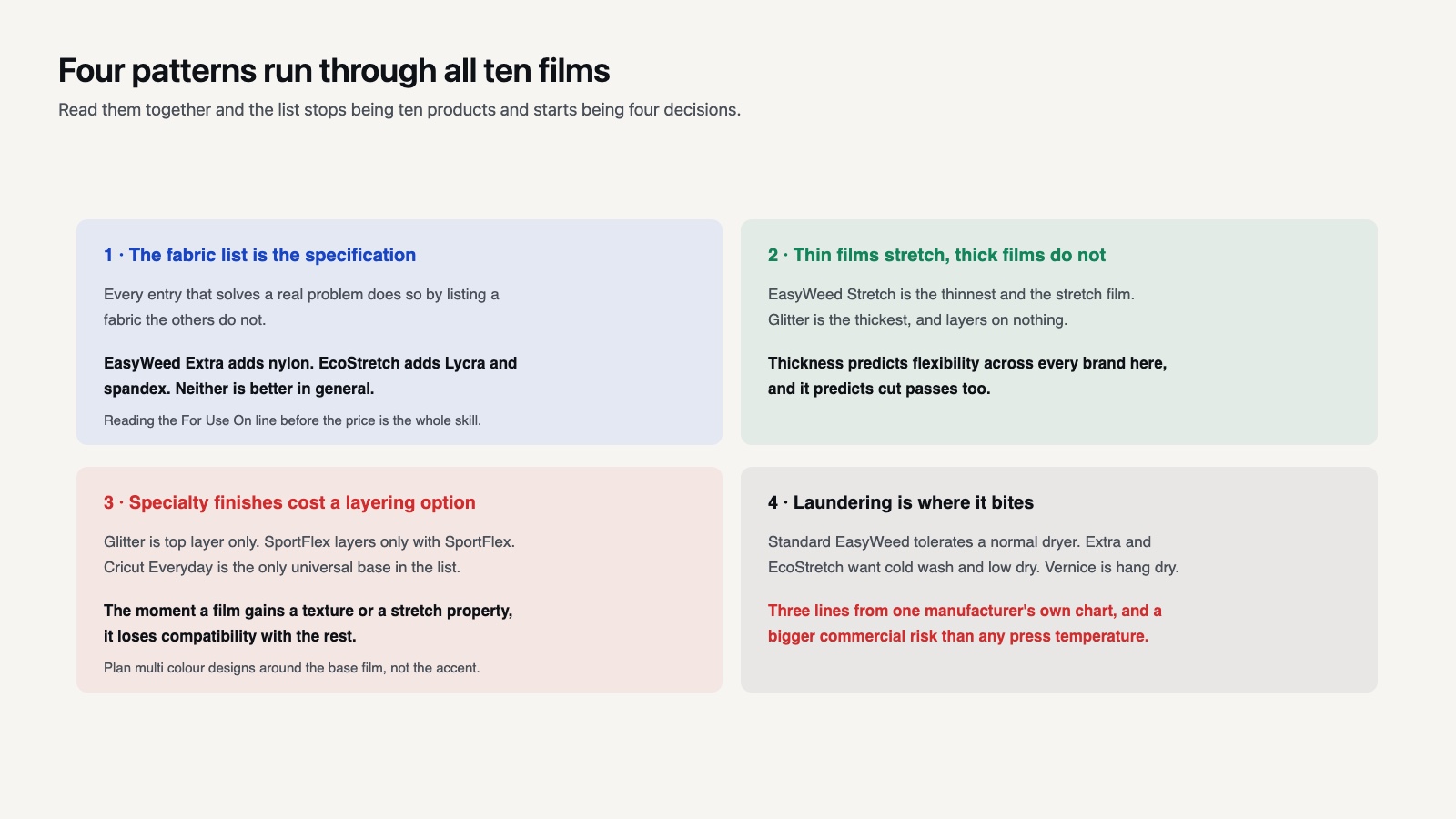
Ten films, and four patterns run through every candidate for best heat transfer vinyl for shirts.
The fabric list is the specification
Every entry that solves a real problem does so by listing a fabric the others do not. EasyWeed Extra adds nylon; EcoStretch adds Lycra and spandex. Neither is better than standard EasyWeed in general, and both are the only correct answer for their fabric. Reading the For Use On line before the price is the whole skill.
Thin films stretch, thick films do not
EasyWeed Stretch is Siser’s thinnest film and its stretch film; Glitter is its thickest and cannot be layered or flexed. Cricut SportFlex is described as thin, lightweight and stretchable in the same sentence. Thickness predicts flexibility across every brand here, and it also predicts how many cut passes you will need.
Specialty finishes cost you a layering option
Glitter is top layer only. SportFlex layers only with SportFlex. Cricut Everyday is the only film in the list explicitly designed as a universal base. The moment a film gains a texture or a stretch property, it loses compatibility with the others, which is why multi color designs should be planned around the base film rather than the accent.
One manufacturer documents better than the other
Siser publishes temperature, time, pressure and peel for every film in a single downloadable sheet. Cricut routes you through an interactive Heat Guide that asks for your press and garment first. Both work, but they suit different users: the sheet is faster once you know your setup, and the guide is safer when you do not. Anyone working from a mixed set of materials ends up wanting the sheet pinned to the wall, alongside the rest of the tips and settings notes.
Laundering is where the differences bite
Standard EasyWeed tolerates a normal dryer. EasyWeed Extra and EcoStretch want cold wash and low dry. Vernice is hang dry only. Those three lines, quoted from one manufacturer’s own chart, are a bigger commercial risk than any difference in press temperature, because the customer controls the washing machine and you do not.
Wrapping Up
Quick Recap:
- Pick the film from the garment’s fabric, then worry about color and finish.
- Siser EasyWeed at 305°F for 10 to 15 seconds covers cotton and blends and forgives peel timing.
- Nylon needs EasyWeed Extra, and real stretch needs EcoStretch, SportFlex or EasyWeed Stretch.
- Check the laundering line before you sell anything, because hang dry only is a returns problem.
Frequently Asked Questions
Which of these works on polyester without scorching?
EasyWeed EcoStretch, because it applies at 250°F rather than 305°F. That 55 degree gap is the difference between safe and marginal on dark polyester, where dye migration turns white vinyl pink. Cricut SportFlex is the equivalent choice inside the Cricut range.
Which one can I layer with anything else?
Cricut Everyday Iron-On, which Cricut specifically identifies as the film that can act as a base for any other Cricut heat transfer material. Within the Siser range, standard EasyWeed is the practical base, with Electric and EasyPatterns Plus layering on top at the same settings.
Which needs a heat press rather than a household iron?
EasyWeed Stretch and Vernice both specify firm pressure, and Vernice needs 320°F for a full 20 seconds. Neither is realistic with a household iron on an ironing board. Standard EasyWeed and EasyWeed Extra can be applied with an iron on a hard flat surface, which Siser documents as an alternative method.
Which is cheapest to work with?
Cricut Value Iron-On per sheet, and standard Siser EasyWeed per usable design once you account for wasted sheets. The cheapest film is the one you waste least of, and forgiving peel behavior saves more material than a lower shelf price does. Design files matter here too, since a well drawn cut ready lettering set weeds without tearing and a badly drawn one costs you a sheet.
Do any of these work on mugs or tumblers?
None of them properly. HTV needs even pressure across a flat plane, and a curved vessel cannot provide it with a flat press. Drinkware is sublimation territory or adhesive vinyl territory, and tumbler designs are built for those methods rather than for heat transfer film.