




Sublimation Temp and Time: Settings Guide by Blank
 Published
 Updated

Sublimation temp and time depend on the blank, not on the printer or the ink. Polyester fabric presses at 400°F for 35 to 40 seconds, ceramic mugs at 350 to 400°F for 150 to 210 seconds, and coated metal at 400°F for 60 seconds, all at roughly 40 psi of medium pressure.
Those three sublimation temp and time figures cover most of what a home setup actually makes, and they come from Sawgrass rather than from a crafting forum. The spread between them is the point: a mug needs four times the press time of a shirt because heat has to travel through a ceramic wall before it reaches the coating.
What follows is the published settings for common blanks, why each one differs, and the handful of adjustments that matter more than the numbers. Sublimation is unforgiving in one direction and forgiving in the other, which is worth understanding before you press anything expensive.
The Published Settings, by Blank
Sawgrass publishes a sublimation temp and time chart covering the substrates most home and small shop users press. Their own framing is worth repeating: the chart is a starting place, and quality output also depends on a calibrated press, suitable blanks and testing.
Two names in that chart are blank manufacturers rather than categories. Unisub makes coated hardboard, metal and ceramic blanks and gets its own row because its settings are consistent across its range. Vapor Apparel makes sublimation ready garments and gets its own row at 380 to 390°F, slightly below the generic polyester figure.
Sublimation settings by surface
| Surface | Time | Temp | Note |
|---|---|---|---|
| Polyester fabric | 35 to 40 s | 400°F | Pre press 3 to 5 s |
| Ceramic mugs | 150 to 210 s | 350 to 400°F | Cool after paper removal; see wrap designs |
| Coated metal, Unisub | 60 s | 400°F | Remove plastic coating first |
| Coated metal, other brands | 60 s | 375 to 400°F | Check the maker’s figure |
| Outdoor metal panels | 60 to 90 s | 400°F | Absorbent sheet underneath |
| Mousepads | 45 s | 400°F | Tight knit gives better color |
| Fire retardant plastics | 40 to 75 s | 400°F | Tear paper away immediately |
| Glass and ceramic tiles | 300 to 720 s | 400°F | Press from the back |
Dedicated blank presses are the other variable. A purpose made mug press wraps heat around the whole circumference and runs a fixed program, which removes the time and pressure decisions entirely but only fits the mug sizes it was designed for. A flat press with a mug attachment is more flexible and less consistent.
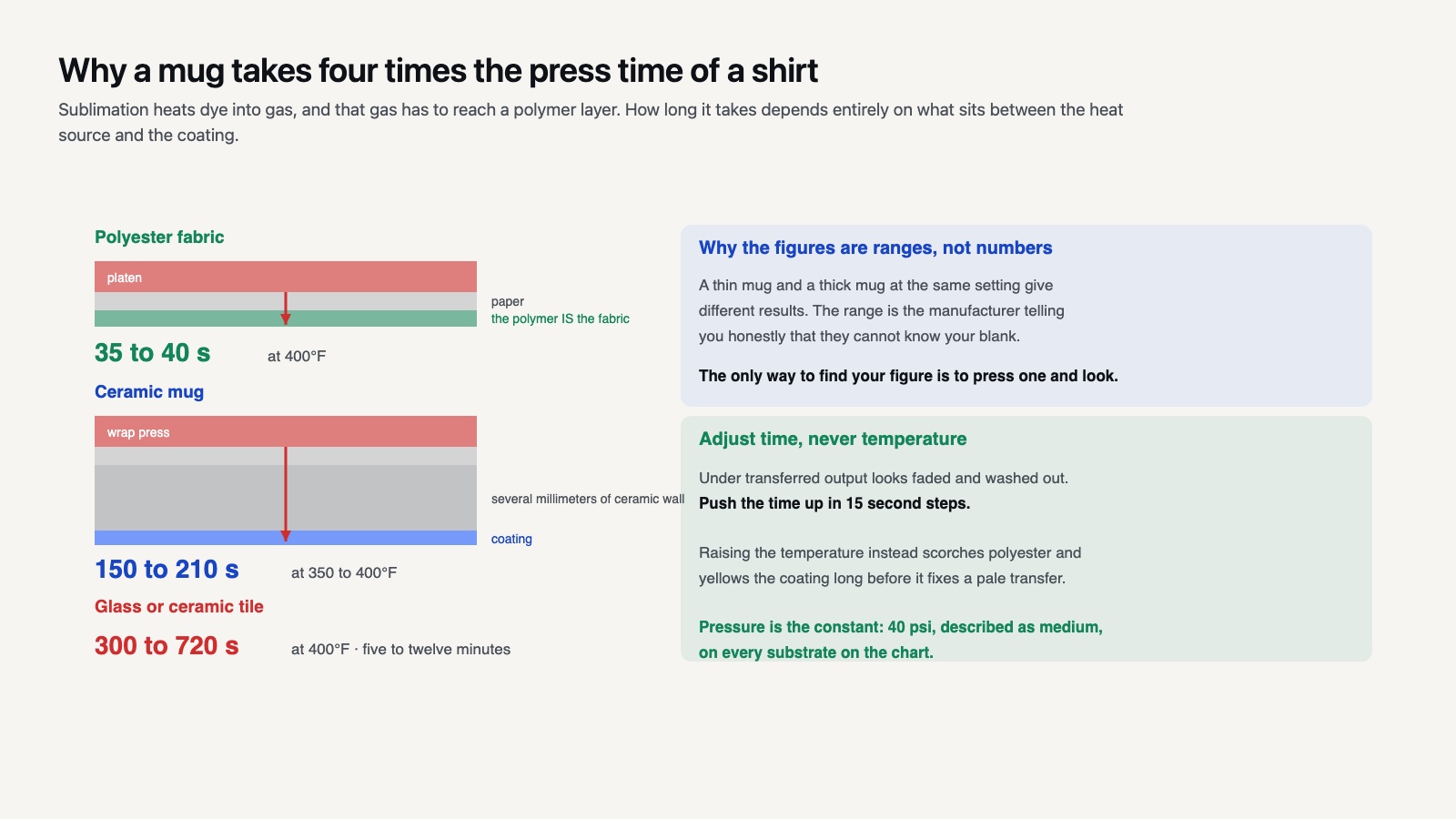
Pressure is 40 psi, described as medium, for every row on the chart. That consistency is useful: unlike heat transfer vinyl, where pressure varies by film, sublimation pressure is broadly the same everywhere and the variable you adjust is time. The full Sawgrass settings reference is worth keeping open, and there is a printable version for pinning next to the press.
📐 Technical Note
40 psi is a pressure measurement, not a dial position. Most consumer presses have no gauge, so calibrate by feel: at correct pressure the handle takes real effort to close and the platen leaves a visible impression in a folded towel. If it closes with one finger, you are well under.
Keep in mind that these are press settings, not design settings. What you feed the press has to be a print ready file at the right resolution, and a 72 dpi image scaled up will look soft no matter how well the transfer goes. Ready made sublimation and decal artwork is supplied at print resolution for that reason.
Why Do the Times Vary So Much?
Sublimation temp and time vary because the process turns solid dye into gas, which then bonds with a polymer. The heat has to reach the polymer layer, and how long that takes depends entirely on what sits between the heat source and the coating.
Polyester fabric is thin and the polymer is the fabric itself, so heat reaches it almost immediately: 35 to 40 seconds. A ceramic mug has a wall several millimeters thick, and the press only touches the outside, so the coating takes minutes rather than seconds to reach temperature. A glass tile is thicker again, which is why the chart allows anything from five to twelve minutes.
Thickness is also why the same design behaves differently on two blanks that look alike. A slim travel mug and a standard ceramic mug take different times, and a coated tumbler wrap design printed for one will look under transferred on the other even though nothing about the artwork changed.
This also explains why the numbers are ranges rather than single figures. A thin mug and a thick mug at the same setting will produce different results, and the only way to find your figure is to press one and look at it. The range is the manufacturer telling you honestly that they cannot know your blank.
The practical consequence is that time is the variable you adjust and temperature is not. Under transferred output looks faded and washed out; push the time up in 15 second steps. Raising temperature instead scorches polyester and yellows the coating long before it fixes a pale transfer.
🔢 Quick Numbers
- 35 to 40 seconds at 400°F for polyester fabric, per the Sawgrass sublimation settings chart
- 150 to 210 seconds at 350 to 400°F for ceramic mugs, per the same chart
- 300 to 720 seconds at 400°F for glass and ceramic flat tiles, per the same chart
- 40 psi medium pressure across every substrate on the chart, per Sawgrass
Pre Pressing, Ghosting and the Two Sheets
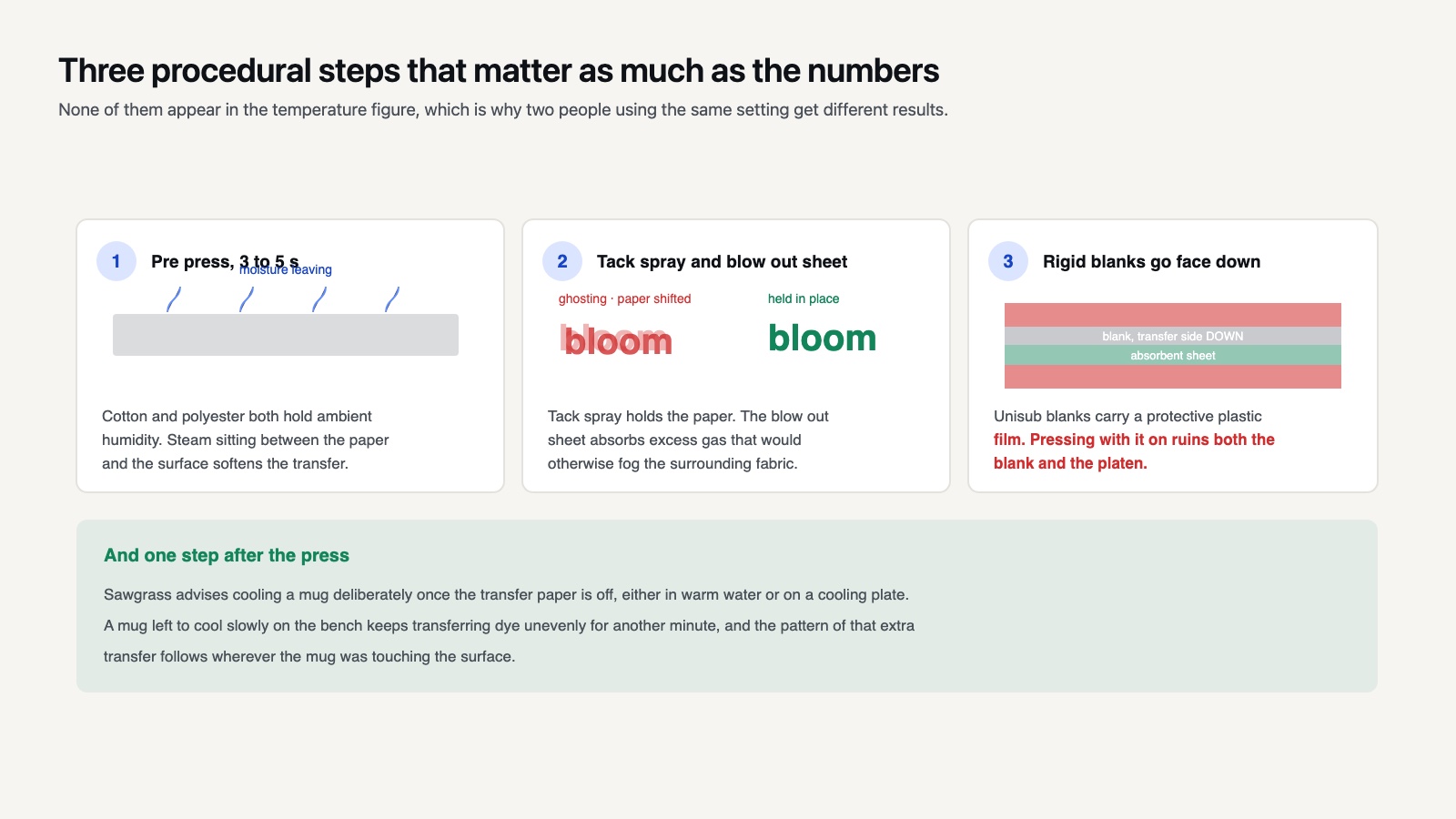
Three procedural steps appear in the Sawgrass notes and they matter as much as the numbers.
Pre press the garment for 3 to 5 seconds before the transfer goes on. This removes moisture, and moisture is what turns a crisp transfer into a soft one. Cotton and polyester both hold ambient humidity, and a shirt straight out of a cold cabinet holds more.
Use tack spray and a blow out sheet on fabric to prevent ghosting. Ghosting is the faint double image you get when the paper shifts by a millimeter as you open the press, and it is the single most common fabric sublimation defect. Tack spray holds the paper; the blow out sheet absorbs excess gas that would otherwise fog the surrounding fabric.
On metal and rigid blanks the instruction is different: place an absorbent sheet on the bottom platen and press the blank face down onto it. Unisub blanks also carry a protective plastic film that has to be peeled off first, and pressing with it on ruins both the blank and the platen.
These steps are the difference between output that looks homemade and output that looks bought. None of them appear in the temperature figure, which is why two people using the same setting get different results. The same principle runs through heat transfer work generally, where preparation decides more than the press does.
💡 Pro Tip
Cool mugs deliberately rather than letting them sit. Sawgrass advises cooling after the transfer paper is removed, either in a bucket of warm water or on a cooling plate. A mug left to cool slowly on the bench keeps transferring dye unevenly for another minute, and the pattern of that extra transfer follows wherever the mug was touching the surface.
What Sublimation Will Not Do
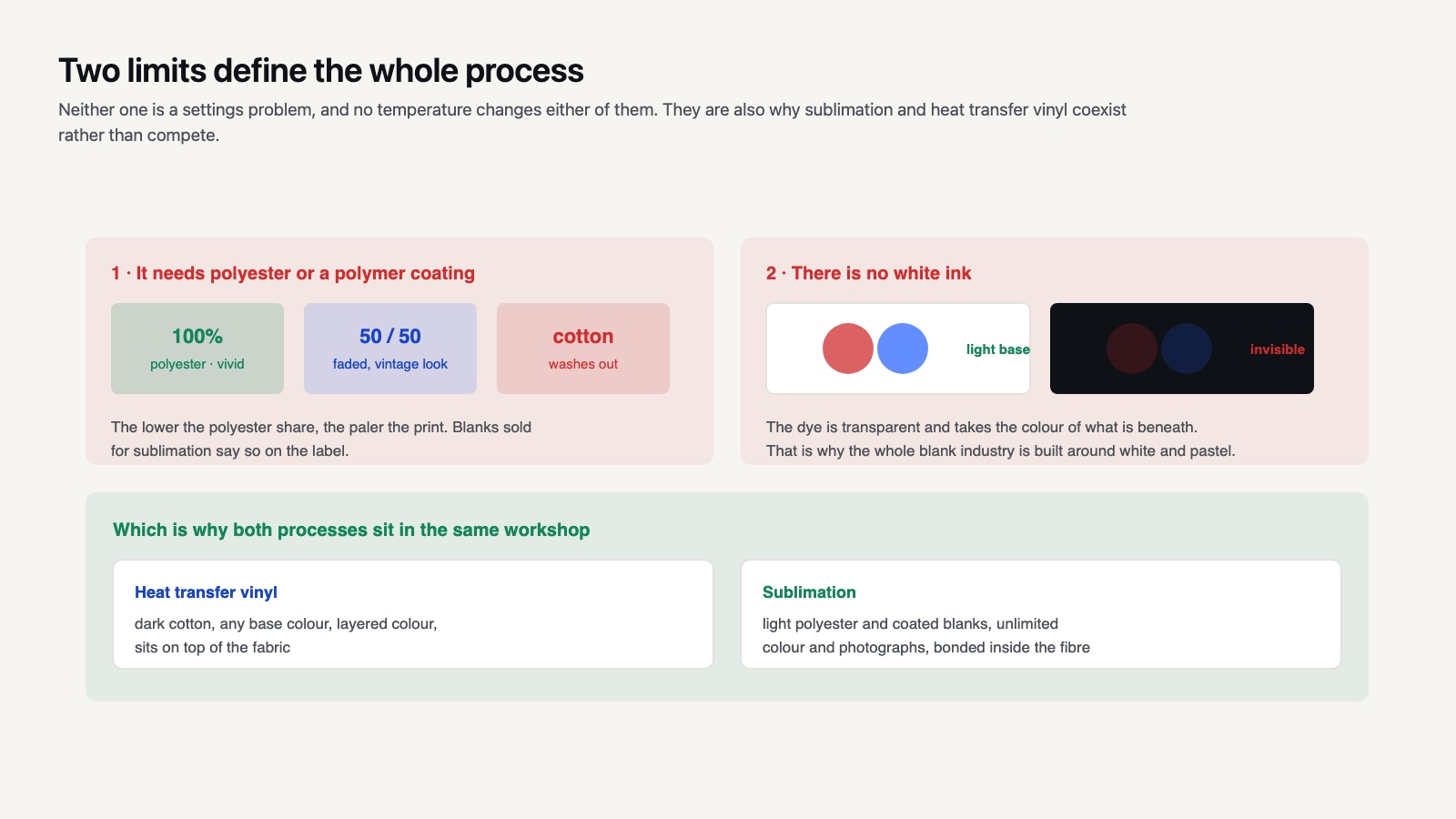
Two limits define the whole process, and neither is a settings problem.
Sublimation needs polyester or a polymer coating. It will not print on 100 percent cotton, and no temperature changes that. Blends work in proportion to their polyester content, so a 50/50 shirt gives a faded, vintage looking result that some people want deliberately and others mistake for an under press. The lower the polyester share, the paler the finished print, and blanks sold for sublimation say so on the label.
Sublimation has no white ink. The dye is transparent and takes the color of what is beneath it, so a design printed onto a black shirt is invisible. Light colored polyester is the only base that works, which is why the entire sublimation blank industry is built around white and pastel items.
Those two constraints are why sublimation and heat transfer vinyl coexist rather than compete. HTV goes on dark cotton; sublimation goes on light polyester and hard coated blanks. Most shops that do volume run both, choosing per job rather than per preference. The shirt design ideas that work in vinyl usually work in sublimation too, with the base color as the only real constraint.
Which Blanks Are Worth Starting With?
Start with polyester shirts and coated ceramic mugs, in that order.
Shirts are the cheapest way to learn, the press time is short enough to iterate quickly, and a failed shirt costs a few dollars. Mugs are the highest volume seller for most small shops and the settings are well documented, but the long press time means each test costs three minutes and a mug.
Leave tiles, metal panels and anything with a manufacturer specific setting until you trust your press. Getting comfortable with your equipment first, as covered in the machine basics guide, saves material later. The chart’s widest range, 300 to 720 seconds for tiles, exists because tile substrates vary enormously, and finding your figure by trial costs an hour and several tiles.
Design files for sublimation are a different category from cut files, and this trips people up when they buy. Sublimation needs a full color PNG with a transparent background at print resolution, not an SVG. An SVG will work if you rasterize it first, but it is not the native format, and the ready made tumbler and drinkware wraps are supplied as PNG for exactly that reason.
When the Result Looks Wrong
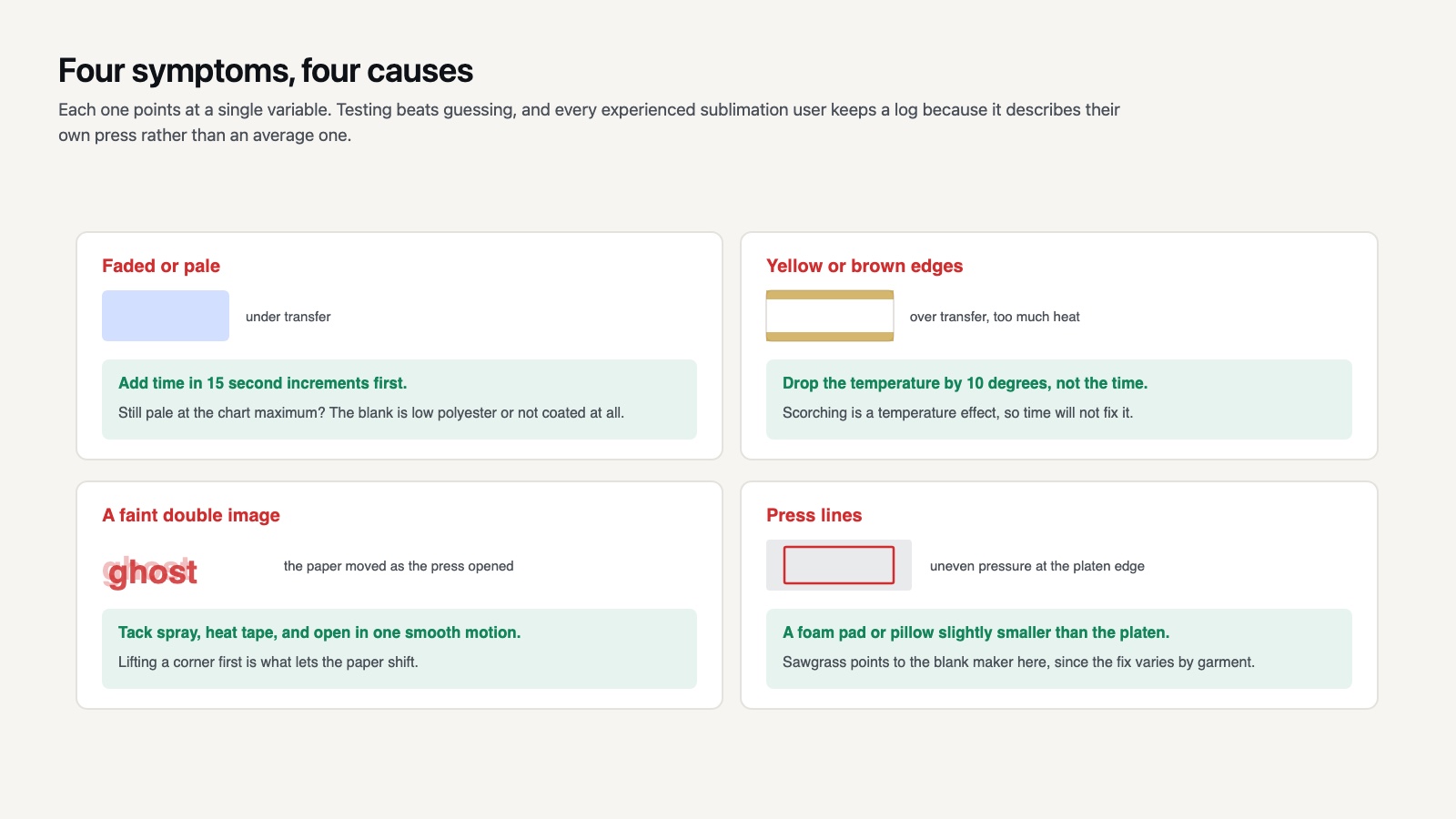
Four symptoms cover nearly everything, and each points at one cause.
Faded or pale output means under transfer. Add time in 15 second increments before touching anything else. If the maximum time on the chart still gives pale output, the blank is either low polyester content or not sublimation coated at all.
Yellow or brown edges mean over transfer or too much heat. Drop the temperature by 10 degrees, not the time, because scorching is a temperature effect.
A faint double image is ghosting, caused by paper movement. Tack spray, heat tape, and opening the press in one smooth motion rather than lifting a corner first.
Press lines, the visible rectangle where the platen edge sat, come from uneven pressure at the boundary. A foam pressing pad or a pillow slightly smaller than the platen spreads that edge out. Sawgrass points to the blank manufacturer for this, naming Vapor Apparel’s own guidance on reducing press lines, because the fix varies by garment.
Beyond that, the honest answer is testing. Every experienced sublimation user keeps a log of blank, press, time and temperature, and that log is worth more than any published chart because it describes their own equipment. The tips and troubleshooting section collects the same habit applied to cutting and pressing generally.
The Bigger Picture
Bottom Line: Learn three settings properly, polyester fabric at 400°F for 35 to 40 seconds, mugs at 350 to 400°F for two and a half to three and a half minutes, and coated metal at 400°F for a minute. Adjust time rather than temperature, pre press everything, and treat the published chart as the starting point its authors say it is.
Frequently Asked Questions
Can I sublimate onto cotton?
Not permanently. The dye needs a polymer to bond with and cotton fibers have none, so the image washes out. Polyester coated sprays and cotton specific transfer papers exist, but those are different processes wearing the same name rather than true sublimation.
Why is my sublimation print dull compared to the screen?
Sublimation ink looks dull on paper and brightens dramatically when heat converts it. If the pressed result is still dull, the usual causes are insufficient time, a blank with low polyester content, or color management left at default. Judge the output after pressing, never before.
Do I need a special printer?
You need sublimation ink, which in practice means either a dedicated sublimation printer or a compatible inkjet converted with sublimation ink from the outset. A printer that has run normal ink cannot be converted reliably, because residue in the head contaminates the sublimation ink.
How long should I wait before washing a sublimated shirt?
Unlike heat transfer vinyl, there is no curing wait. The dye is bonded inside the fiber as soon as it cools, so a sublimated garment can be washed immediately. That permanence is the main advantage sublimation has over any surface applied method.